

An optical isolator is a passive device that enables unidirectional light transmission and is crucial for ensuring the stable operation of lasers and other optical systems. Its main application areas include fiber-optic communication networks, laser systems and processing, sensing and measurement systems, as well as quantum technology and scientific research.
| Optical Isolator Characteristic Dimension | Description |
| Core Function | Allows light to pass in the forward direction while highly attenuating or blocking backward light, preventing reflected light from interfering with the light source or optical system. |
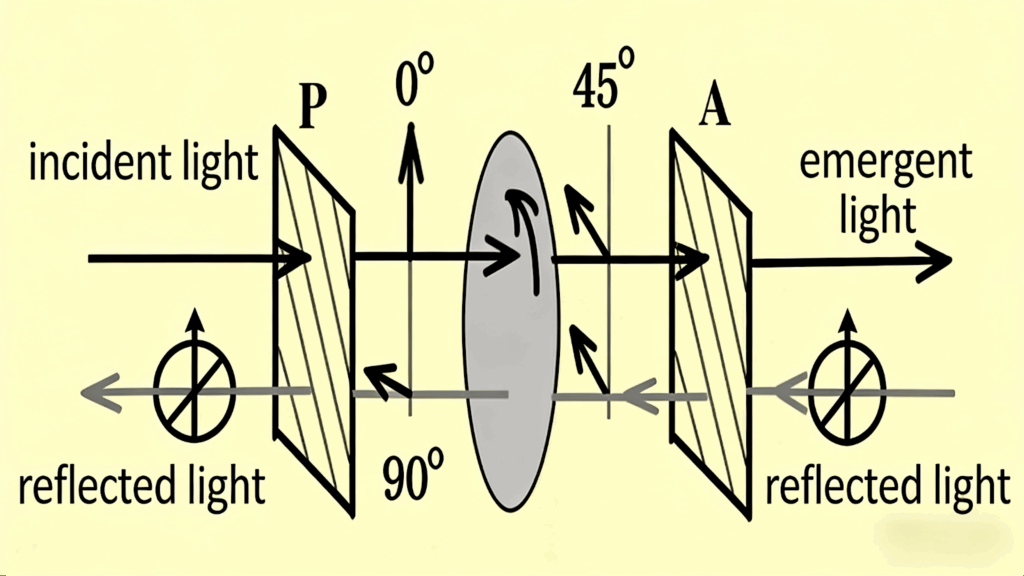
| Basic Principle | Based on the Faraday magneto-optical effect: under the action of a longitudinal magnetic field, the polarization direction of light passing through a magneto-optical material rotates, and the rotation direction is independent of the light propagation direction (see Fig. 1). |
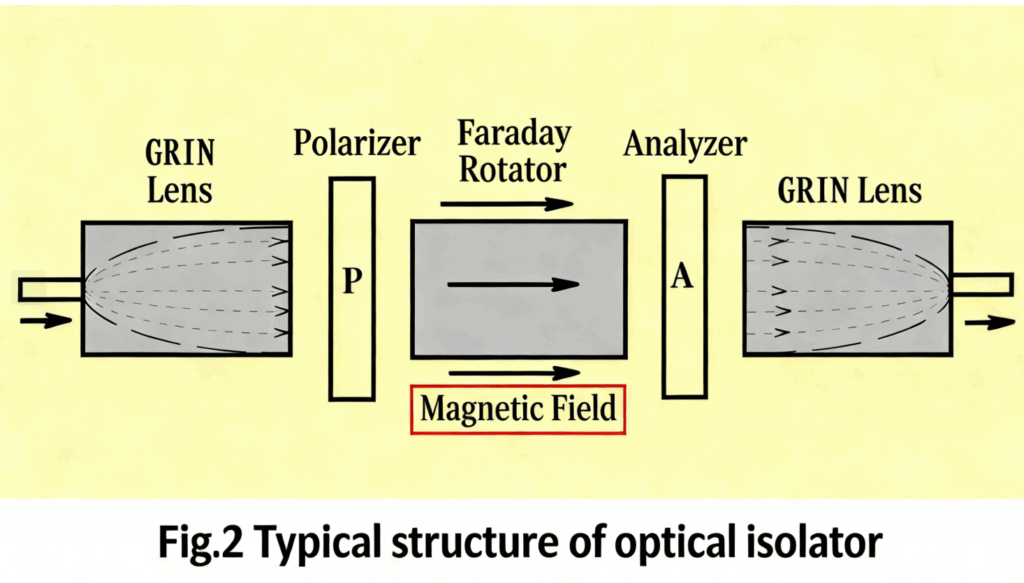
| Typical Structure | Composed of a polarizer, a Faraday rotator (magneto-optical material + permanent magnet), and an analyzer. Forward light has its polarization rotated by 45° and can pass through the analyzer, while backward light has its polarization orthogonal to the analyzer and is therefore blocked (see Fig. 2). |
| Key Materials | Magneto-optical materials: such as yttrium iron garnet (YIG), terbium gallium garnet (TGG), etc., which determine the rotation efficiency. Permanent magnet: generates a stable bias magnetic field (usually several thousand gauss) to drive the Faraday effect. |

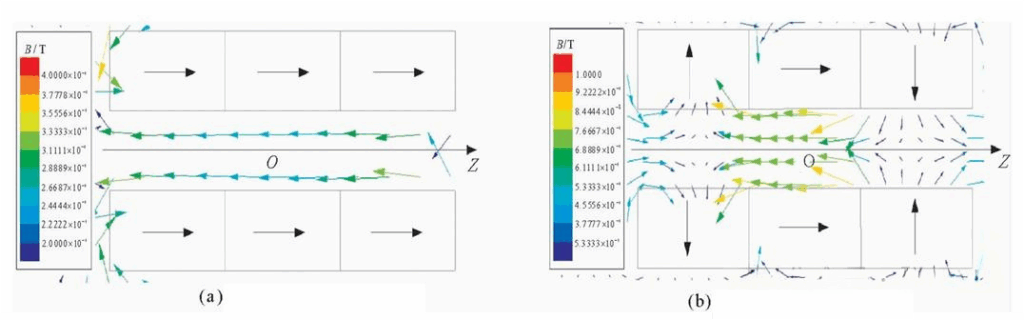
There are two common permanent magnet configurations used in optical isolators:
(1) generating the magnetic field using a single axially magnetized permanent magnet (as shown in Fig. a);
(2) a flux-concentrating design achieved by assembling permanent magnets with different magnetization directions and optimizing their arrangement (as shown in Fig. b).
Permanent magnets are the core component of traditional high-performance bulk optical isolators, providing a stable bias magnetic field for the Faraday rotator.
Therefore, how to select an appropriate permanent magnet for an optical isolator is a key issue. The following aspects should be considered:
1. High magnetic field strength
The permanent magnet must provide a sufficiently strong magnetic field to ensure a significant rotation of the polarization in the Faraday rotator (typically 45° or 90°). The magnetic field strength directly affects the Faraday rotation performance. If the magnetic field is too weak, the required polarization rotation cannot be achieved, leading to degraded isolator performance and ineffective isolation of backward-propagating light.
2. Magnetic field uniformity
The magnetic field must remain highly uniform within the Faraday rotator region to avoid magnetic distortion or non-uniform distribution. An inhomogeneous magnetic field can cause deviations in the polarization rotation angle, resulting in reduced isolation and even partial transmission of backward-propagating light, thereby degrading the unidirectional transmission performance of the isolator.
3. Temperature stability
During the operation of an optical isolator, especially in high-power applications or high-temperature environments, the magnetic properties of the permanent magnet must remain stable. The temperature coefficients of key parameters such as coercivity and remanence should be sufficiently low to prevent changes in magnetic field strength or direction caused by temperature variations, which would otherwise affect the Faraday rotation effect and overall isolator performance.
4. Size and shape compatibility
The size and shape of the permanent magnet must be compatible with the structural design of the optical isolator. For miniaturized and integrated optical isolators (such as those used in fiber-optic communications or chip-level optical systems), the magnet should have a compact volume and specific geometric shapes to provide an effective magnetic field within a limited space, while not interfering with the optical path.
5. Environmental robustness
The permanent magnet should exhibit good resistance to corrosion, vibration, and mechanical shock in order to adapt to various operating environments. In applications such as industrial laser equipment and outdoor communication systems, the magnet must be capable of withstanding harsh environmental conditions to ensure long-term stable operation.
Common permanent magnet materials used in optical isolators include neodymium–iron–boron (NdFeB) magnets and samarium–cobalt (SmCo) magnets. Owing to their high maximum energy product, good temperature stability, and strong potential for miniaturization, they have become the preferred magnetic materials for optical isolators.